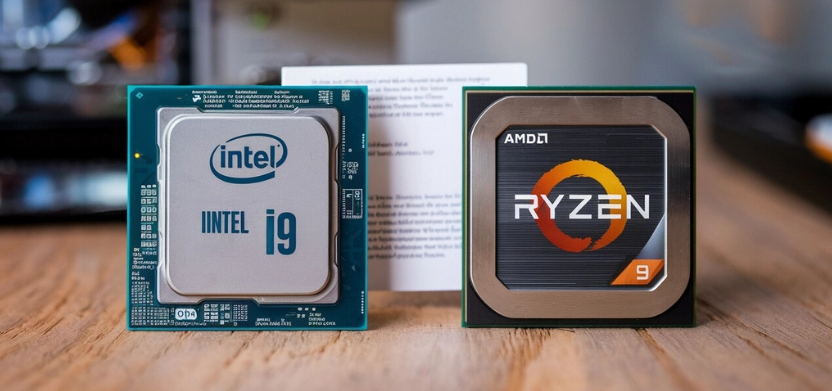
The 30-Second Summary
If gaming is all you care about, a Ryzen with 3D V-Cache usually gets you more frames per dollar. If your day-to-day mixes video editing, software compilation, or heavy multitasking, the two brands are pretty evenly matched. And if you'd rather not swap motherboards every couple of years, AMD's AM5 platform gives you more runway than Intel's newer socket.
1. The Fight Isn't Decided by Clock Speed Anymore
For years, checking the gigahertz number was enough to know which processor performed better. That doesn't hold up anymore. A 2026 chip running at 4.0 GHz can easily outrun an older chip clocked at 5.0 GHz, because what really changed is the internal architecture, not just the frequency.
What actually separates Intel from AMD today comes down to something else entirely: how many real cores you get, how much cache backs them up, and how well each architecture handles the AI workloads that are increasingly baked into the operating system and everyday apps.
2. Where Each One Wins, by Actual Use Case
| Main use | Who usually comes out on top |
|---|---|
| Pure gaming | AMD Ryzen X3D (extra cache = more FPS) |
| Video editing / rendering | Roughly tied, Intel has an edge with Quick Sync in Premiere |
| Programming and compiling | AMD, thanks to more physical cores |
| Office work and study | Either one is more than enough |
| Premium laptop / battery life | Intel Core Ultra usually handles battery better |
*This is a general guide, not a hard rule: specific models within each brand can buck the trend.
3. A Detail Almost Nobody Mentions: The Socket
Before you even look at benchmarks, it's worth checking the motherboard, because there's a real difference between the two brands here. AMD has kept its AM5 platform going for several generations now, which in practice means you can upgrade the processor later without throwing out the motherboard. Intel, on the other hand, tends to change sockets more often, so buying today doesn't always guarantee the next generation of chips will fit the same board.
If you plan on keeping the build for several years and just upgrading the processor down the line, that platform continuity matters more than it seems at first glance.
4. What About Built-In AI?
Both AMD's new Ryzen AI chips and Intel's Core Ultra line now ship with a dedicated block for local AI tasks, meant for things like background blur in video calls, real-time image enhancement, or assistants that run directly on the device without relying on the cloud. Neither brand has a clear knockout advantage here yet: the real difference still shows up more in the software that takes advantage of those blocks than in the hardware itself.
5. Frequently Asked Questions
Should I wait for the next generation before buying?
There's always something new around the corner. If the current lineup covers what you need today, waiting indefinitely rarely pays off.
Is an i5 or a Ryzen 5 enough for gaming?
For most current games, yes, as long as you pair it with a decent graphics card. Higher-end models matter more for content creation than for pure gaming.
Is it worth paying more for an AMD X3D model?
If gaming is your main use, that extra cache usually translates into consistently higher frame rates. For other tasks, the price premium isn't always justified.
This article is for educational and informational purposes. Prices and reference models may vary depending on the market and the time of purchase.